
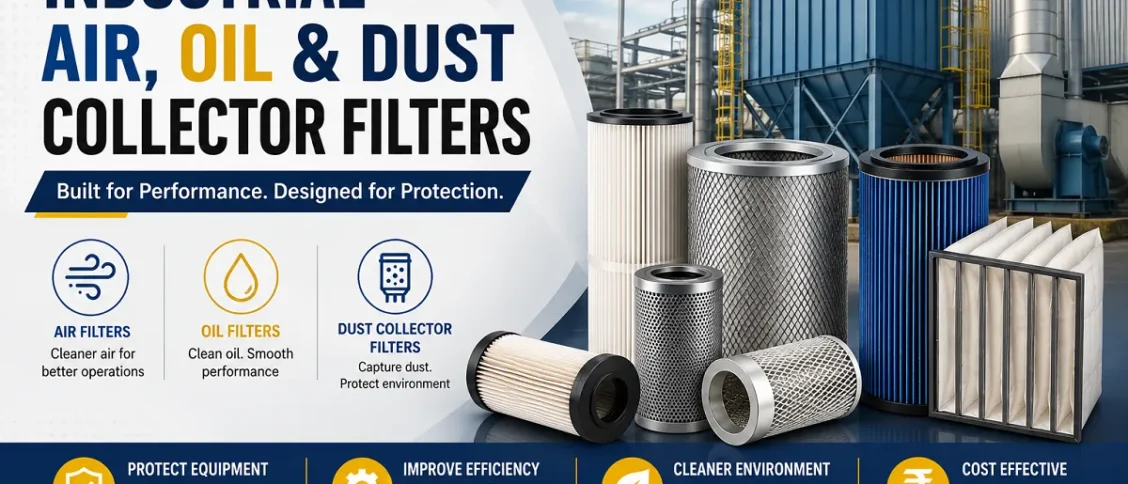
Industrial equipment and production facilities depend heavily on clean air and clean fluids to operate efficiently. Dust, metal particles, fibres, oil contamination and other unwanted materials can gradually affect machinery, production quality and workplace conditions.
This is why industrial filtration is an important part of modern manufacturing and processing operations.
Businesses in Hyderabad operate across many industries, including pharmaceuticals, engineering, chemicals, food processing, automotive manufacturing, power generation and metalworking. Although these industries are different, they often face a common challenge: controlling contamination.
The right industrial filter can help protect equipment, support smoother operations and reduce unnecessary maintenance problems. However, selecting a filter is not simply a matter of finding one that looks similar to the existing component.
Airflow, particle type, fluid compatibility, pressure, temperature and operating conditions all need to be considered.
This guide explains the main types of industrial filtration products and the important factors businesses should consider when selecting air filters, oil filters and dust collector filters in Hyderabad.
Why Industrial Filtration Is Important
Industrial environments can produce contamination in many different ways.
Dust may be generated during cutting, grinding or material handling. Fine particles can circulate through ventilation systems. Hydraulic systems can accumulate particles from component wear. Lubricating oil may become contaminated during normal equipment operation.
Without suitable filtration, these contaminants can create several operational problems.
They may contribute to:
- Increased equipment wear
- Reduced system efficiency
- More frequent maintenance
- Blockages and restricted flow
- Poorer workplace air conditions
- Damage to sensitive machine components
- Interruptions to production
The purpose of industrial filtration is to control these contaminants before they create larger problems within the system.
However, every application is different. A filter designed for a high-volume air handling system will have very different requirements from a filter protecting a hydraulic pump or collecting fine industrial powder.
The Three Major Categories of Industrial Filters
Although industrial filtration includes many specialised products, three important categories are commonly used across different industries.
Industrial Air Filters
Air filters are used to remove unwanted particles from moving air.
They may be installed in:
- Air handling systems
- Industrial ventilation systems
- Machinery
- Production equipment
- Compressors
- Manufacturing facilities
The type of particles being controlled can range from relatively large dust particles to much finer airborne contaminants.
Industrial Oil and Hydraulic Filters
Oil filters are used to control contamination in systems containing lubricating or hydraulic fluids.
Common applications include:
- Hydraulic equipment
- Industrial pumps
- Gear systems
- Lubrication circuits
- Manufacturing machinery
- Heavy engineering equipment
The objective is to help prevent unwanted particles from circulating through components that may be sensitive to contamination.
Dust Collector Filters
Dust collection filters are specifically used in systems designed to capture particles produced during industrial operations.
They are commonly associated with activities such as:
- Grinding
- Cutting
- Welding
- Powder handling
- Sanding
- Mixing
- Material transfer
- Manufacturing processes
The correct filter depends greatly on the physical nature of the dust being generated.
How to Select the Right Industrial Air Filter
Air filtration requirements can vary significantly from one facility to another.
A factory handling heavy materials may have completely different requirements from a controlled pharmaceutical production environment. For this reason, businesses should consider the actual working environment before selecting a filter.
Consider the Required Air Volume
Every air filtration system operates with a specific airflow requirement.
The filter must allow sufficient air to pass through while still capturing the required contaminants.
If a filter creates too much resistance, it may place additional strain on the overall system. On the other hand, a filter that does not provide suitable filtration may allow excessive contamination to pass through.
The balance between filtration performance and airflow is therefore important.
Identify the Particle Type
Not all airborne particles behave in the same way.
An industrial environment may contain:
- Coarse dust
- Fine powder
- Fibres
- Process particles
- Metal particles
- Other suspended materials
Understanding the type of contamination helps determine the filtration media and performance requirements.
Review the Working Conditions
Environmental conditions should also be considered.
Questions worth asking include:
- Is the area heavily dusty?
- Is the temperature high?
- Does the system operate continuously?
- Is the air relatively clean or heavily contaminated?
- Are fine particles a major concern?
A filter that works well in one location may not necessarily be suitable for another.
The Role of Oil Filtration in Industrial Machinery
Industrial machinery often depends on hydraulic or lubricating fluids for proper operation.
During normal use, these fluids can collect contaminants from different sources.
For example, particles may enter through:
- Component wear
- External dust
- Maintenance work
- Fluid handling
- System openings
- Production conditions
Even small particles can become a concern when they circulate repeatedly through sensitive equipment.
Proper oil filtration helps manage contamination within the system.
Understanding Filtration Performance
The required level of filtration depends on the equipment being protected.
Some systems require more controlled cleanliness levels because of sensitive components. Other applications may have different operational tolerances.
Selecting an unnecessarily restrictive filter can also create problems if it reduces flow beyond acceptable levels.
The goal should be to select a filtration level that suits the actual equipment and operating conditions.
Flow Capacity Matters
An oil filter should be capable of handling the amount of fluid moving through the system.
If the filter is incorrectly selected, excessive flow resistance may affect system performance.
Before choosing a replacement or new filter, it is useful to know the expected flow rate.
Pressure Conditions Must Be Considered
Industrial hydraulic and lubrication systems can operate under demanding pressure conditions.
The filter housing, media and associated components must be appropriate for the system.
Both normal operating conditions and possible pressure variations should be considered during selection.
Material Compatibility Is Essential
The filter must be compatible with the fluid being used.
Different oils and industrial fluids may require different materials for:
- Filter media
- Seals
- Gaskets
- Internal components
Providing accurate fluid information to a filtration supplier can help avoid compatibility issues.
Dust Collection Filters and Industrial Workplace Conditions
Dust is produced during a wide range of industrial activities.
In some facilities, the particles may be large and heavy. In others, the process may create extremely fine powder that remains suspended in the air.
This means there is no universal dust collector filter suitable for every application.
Understanding the Nature of the Dust
Before selecting a dust collector filter, businesses should understand what the system is collecting.
Important characteristics may include:
- Particle size
- Particle shape
- Dust quantity
- Moisture conditions
- Density
- Whether the material is fibrous
- Whether the particles are coarse or fine
These characteristics can influence filter selection and maintenance requirements.
Check the Existing System Design
When replacing a dust collector filter, it is important to check the specifications of the existing system.
This can include:
- Filter dimensions
- Installation method
- Airflow
- Filter configuration
- Equipment design
- Operating conditions
Simply selecting a replacement based on appearance can lead to incorrect fitment or unsuitable performance.
Consider Maintenance Requirements
All filters gradually collect contaminants.
As more particles accumulate, resistance can increase and system performance may be affected.
Businesses should consider how frequently filters need to be inspected, cleaned or replaced.
A practical maintenance plan can help avoid unexpected operational problems.
Industries That Use Industrial Filtration Products
Industrial filters are used across a wide variety of sectors in Hyderabad and throughout India.
Pharmaceutical Manufacturing
Pharmaceutical facilities often require controlled environments and careful management of particulate contamination during different production processes.
Air and dust filtration can form part of the wider environmental control system.
Chemical Processing
Chemical applications may involve demanding operating conditions and different types of fluids.
Material compatibility is an important consideration when selecting suitable filtration components.
Engineering and Fabrication
Engineering facilities may generate dust, metal particles and other contaminants during cutting, grinding and manufacturing.
Air, oil and dust filtration can support cleaner operations and equipment protection.
Food Processing
Filtration requirements in food processing can vary depending on the process, equipment and materials involved.
Different stages of production may require different approaches to managing particles and contaminants.
Automotive Manufacturing
Automotive production facilities use a wide range of machinery and systems.
Filtration can be used in lubrication circuits, hydraulic equipment, ventilation systems and manufacturing processes.
Power and Energy Operations
Equipment used in power and energy applications may operate for long periods under demanding conditions.
Suitable filtration can help manage contamination affecting important components and systems.
Important Questions to Ask Before Ordering an Industrial Filter
Businesses can make the filter selection process easier by preparing technical information before contacting a supplier.
The following details can be particularly useful:
| Information Required | Why It Is Important |
|---|---|
| Application | Helps identify the correct filter category |
| Equipment type | Helps understand the operating requirements |
| Contaminant | Helps determine filtration needs |
| Airflow or flow rate | Supports correct sizing |
| Operating pressure | Helps determine suitable components |
| Temperature | Influences material selection |
| Existing dimensions | Helps identify compatible replacements |
| Fluid type | Important for oil and hydraulic filters |
| Operating environment | Helps select suitable filter media |
Providing complete information reduces the chances of selecting an unsuitable filter.
Common Problems Caused by Incorrect Filter Selection
Choosing an industrial filter without understanding the application can create unnecessary problems.
Selecting Only by Physical Size
Two filters may have similar dimensions but completely different performance characteristics.
A correct fit does not automatically mean the filter is suitable for the application.
Buying the Cheapest Available Option
Price is naturally an important consideration, but the purchase price is only one part of the overall cost.
A lower-cost filter may require more frequent replacement or may not provide suitable performance for the equipment.
Businesses should consider the overall operating requirements rather than focusing only on the initial price.
Choosing Maximum Filtration Without Checking System Requirements
A finer filter is not always the better choice.
Very fine filtration may increase resistance to airflow or fluid flow, depending on the application.
The filtration requirement should match the needs of the system.
Ignoring Temperature and Pressure
A filter may appear suitable under normal conditions but fail to perform as expected if temperature or pressure requirements have not been properly reviewed.
Operating conditions should always be part of the selection process.
Delaying Inspection and Replacement
Filters do not remain equally efficient indefinitely.
As contaminants accumulate, flow resistance can increase.
Regular inspection and replacement according to operational requirements can help maintain system performance.
Standard Filters vs Application-Specific Solutions
Many industrial applications can use standard filter sizes and configurations.
However, some systems have specialised requirements.
An application-specific filtration solution may be necessary when there are unusual requirements related to:
- Dimensions
- Connections
- Filter media
- Operating pressure
- Temperature
- Flow capacity
- Filtration performance
In such cases, providing technical details to an experienced industrial filtration supplier in Hyderabad can be particularly useful.
Choosing an Industrial Filter Supplier in Hyderabad
Businesses looking for industrial filtration products in Hyderabad should consider more than product availability.
A suitable supplier should be able to understand the application and review the technical requirements before recommending a product.
It is useful to work with a supplier that can discuss factors such as:
- What needs to be filtered
- What contaminants are present
- Equipment specifications
- Existing filter dimensions
- Flow requirements
- Pressure conditions
- Operating temperature
- Maintenance expectations
A broader range of filtration products can also be useful for businesses operating multiple types of equipment.
Instead of attempting to use one product for every application, the filtration solution should be selected according to the individual system.
How the Right Filtration Solution Supports Industrial Operations
The benefits of selecting a suitable industrial filter can extend beyond simply removing contaminants.
Application-appropriate filtration may help businesses:
- Protect machinery
- Support consistent system operation
- Manage process contamination
- Improve maintenance planning
- Reduce avoidable equipment problems
- Maintain suitable working conditions
The exact benefits will depend on the equipment, industry and operating environment.
For this reason, filtration should be considered as part of the overall maintenance and operational strategy rather than as a simple replacement purchase.
Frequently Asked Questions
What types of industrial filters are commonly required?
Industrial facilities may use air filters, oil filters, hydraulic filters, dust collector filters, cartridges, filter bags, strainers and other specialised filtration products.
How can I identify the correct replacement filter?
Check the existing filter dimensions, application, operating conditions, flow requirements and filtration specifications. Equipment details can also help identify a suitable replacement.
Are dust collector filters suitable for every type of dust?
No. Different dust characteristics can require different filter media and configurations. The type and behaviour of the particles should be considered before selecting a filter.
Why is hydraulic oil filtration important?
Hydraulic systems can be affected by unwanted particles circulating through the fluid. Suitable filtration helps manage contamination according to the requirements of the equipment.
Can industrial filters be made for specific requirements?
Some industrial applications may require filters with particular dimensions, materials, filtration characteristics or operating capabilities.
What details should I provide to a filter supplier?
Where possible, provide information about the application, equipment, contaminant, airflow or flow rate, pressure, temperature, fluid type and existing filter dimensions.
Conclusion
Industrial air, oil and dust filtration systems perform different functions, but successful filter selection begins with the same principle: understanding the actual application.
A filter should not be selected only because it is inexpensive or physically similar to an existing product.
Businesses should consider the type of contamination, equipment requirements, airflow or fluid flow, pressure, temperature and working environment.
For industrial facilities in Hyderabad, choosing the right filtration solution can help support equipment protection, cleaner processes and more efficient maintenance planning.
Whether the requirement involves industrial air filtration, hydraulic oil filtration or dust collection, providing accurate technical information is one of the best ways to identify a filter that matches the needs of the system.